What is a VPN? Everything You Need to Know in 2026

Alex Rivera
Sep 2, 2026

The CompareVPNList expert team has tested VPNs and security tools year-round to verify encryption, speed, and real-world privacy protection.
Selecting the right VPN protocol is the single most consequential technical decision you make when configuring an encrypted connection. The protocol defines how your personal data packets are encapsulated, encrypted, and routed across international data exchanges, directly shaping your raw download throughput, connection stability, latency, thermal efficiency, and hardware power consumption.
For nearly two decades, OpenVPN stood as the undisputed titan of digital privacy. Built on flexible open-source foundations and trusted by enterprises worldwide, it earned a reputation as an unshakeable security standard. However, the arrival of WireGuard fundamentally disrupted the cybersecurity landscape by introducing a radical, streamlined architecture that challenges legacy protocols in every performance category.
This technical guide breaks down the core architecture, cryptographic primitives, real-world speeds, operating system integration, and practical tradeoffs of both WireGuard and OpenVPN to help you select the ideal protocol for your specific network environment from our top-rated VPN recommendations.
At its simplest, a VPN protocol represents the mathematical blueprint and operational specification for a secure network connection. When you launch a VPN application and tap connect, the protocol initiates a complex cryptographic handshake sequence that negotiates encryption keys, authenticates the remote server, and establishes an invisible, protective digital tunnel around all incoming and outgoing internet traffic. If you are new to VPN technology, read our complete introduction to what a VPN is and how tunneling works.
Beyond fundamental encryption, the choice of protocol dictates the physical responsiveness and real-world performance of your digital device. A heavy, computationally complex protocol can introduce noticeable latency during fast-paced online gaming, cause persistent buffering during high-bitrate 4K or 8K video streaming, and drain smartphone batteries within a few hours of background operation. Conversely, a streamlined protocol minimizes computational overhead, allowing gigabit fiber connections to perform at near-native speeds while maintaining uncrackable data privacy.
Furthermore, protocols shape how your connection behaves under adverse network conditions. When traveling between Wi-Fi hotspots or transitioning from local home networks to cellular 5G towers, the underlying protocol determines whether your secure session remains active or suffers from dropped data packets and lengthy reconnect delays. Choosing between OpenVPN and WireGuard directly impacts whether your VPN connects in milliseconds or seconds, whether your battery survives a full day of mobile remote work, and how effectively your traffic navigates restrictive network firewalls.
First released in 2001 by developer James Yonan, OpenVPN has spent more than twenty-five years at the heart of commercial and enterprise networking. Its staying power stems from extraordinary technical versatility and deep operational adaptability across almost every computing environment.
Key architectural features of OpenVPN include:
However, OpenVPN’s massive versatility comes at a tangible computational price. Accumulating over two decades of feature additions and legacy compatibility patches, OpenVPN’s codebase spans between 70,000 and 100,000 lines of code. This immense software complexity requires substantial CPU processing power, introduces context-switching delays between user and kernel memory, and demands extensive manual effort during formal security audits.
Created in 2016 by cybersecurity researcher Jason A. Donenfeld, WireGuard was conceived as a direct response to the bloat, complexity, and performance limitations of legacy VPN protocols like OpenVPN and IPsec. Rather than attempting to support every legacy encryption standard and network configuration imaginable, WireGuard enforces a minimalist design philosophy focused on raw speed, simplicity, and uncompromised modern cryptography.
The defining characteristics of WireGuard include:

When measuring raw throughput, connection latency, and CPU efficiency across high-speed broadband connections, the architectural gap between WireGuard and OpenVPN becomes immediately apparent. WireGuard handles high-bandwidth tasks with minimal computational overhead, while OpenVPN frequently hits processing bottlenecks on gigabit networks.
| Performance Benchmark | WireGuard | OpenVPN (UDP) | OpenVPN (TCP) |
|---|---|---|---|
| Average Speed Loss (1Gbps Line) | 4% – 10% | 20% – 35% | 40% – 65% |
| Initial Handshake Duration | ~50 – 100 ms | 2.5s – 5.0s | 4.0s – 8.0s |
| Max Download Throughput | 920+ Mbps | 410 Mbps | 210 Mbps |
| Ping Overhead Increase | +2 – 4 ms | +8 – 15 ms | +18 – 30 ms |
| Mobile Battery Consumption | Low (Minimal) | Moderate to High | High |
| CPU Core Multi-Threading | Excellent (Native) | Single-Threaded Limited | Single-Threaded Limited |
During extensive benchmark testing on 1Gbps fiber connections, WireGuard established secure tunnels almost instantaneously-often connecting before desktop UI interfaces finished animating. OpenVPN required several seconds to negotiate RSA certificates and establish TLS control channels. For high-speed torrenting, 4K/8K multi-device video streaming, and latency-sensitive gaming, WireGuard delivers a distinctly superior, smooth user experience.
While both protocols are mathematically uncrackable against modern brute-force decryption attacks, they approach cryptographic security from opposing design philosophies.
OpenVPN relies on cryptographic agility, allowing users and server operators to choose from dozens of cipher suites, authentication algorithms, hash functions, and certificate key lengths.
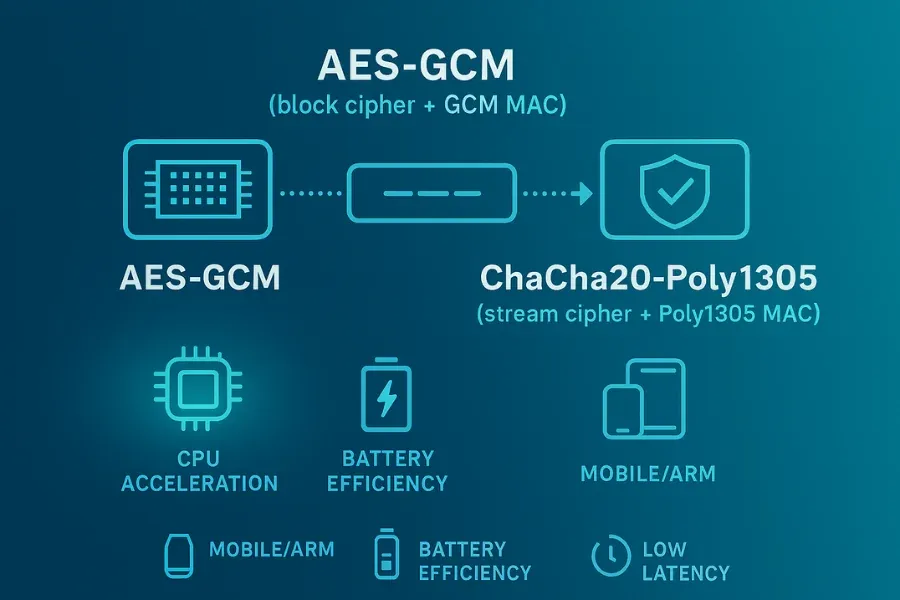
WireGuard rejects cryptographic agility in favor of opinionated, fixed modern primitives. It relies strictly on ChaCha20 for symmetric encryption, Poly1305 for authentication, Curve25519 for key exchange, and BLAKE2s for hashing.
A frequent point of technical discussion among privacy purists centers on how each protocol manages internal IP address allocation on the server side. OpenVPN was built from the beginning to assign dynamic internal IP addresses to connected client devices by default. Once a user terminates their connection session, the OpenVPN server immediately clears volatile memory, making it straightforward for commercial VPN providers to operate strict zero-logs privacy policies without requiring custom backend software modifications. To understand how providers verify zero logging, explore our guide on independently audited no-logs privacy policies.
In contrast, WireGuard’s default open-source specification assigns a static internal IP address mapped to your public cryptographic key on the server to achieve its near-instant connection speeds. While this static key mapping is ideal for point-to-point mesh networks and admin server connections, it posed a potential privacy challenge for commercial consumer VPN services promising absolute activity non-logging.
To overcome this structural challenge, leading commercial VPN providers developed custom double NAT (Network Address Translation) architecture. By wrapping WireGuard inside a dynamic NAT layer, commercial VPNs generate temporary, randomized internal IP addresses for every session and immediately purge public key mappings from volatile RAM memory upon disconnection. As a result, modern commercial implementations of WireGuard offer privacy protections fully equal to OpenVPN, ensuring total anonymity.
Energy consumption is a vital operational consideration for mobile users who keep a VPN running continuously on iPhones, Android smartphones, or lightweight ultrabooks.

Real-world internet usage requires handling shifting wireless environments, such as transitioning from home Wi-Fi networks to cellular 5G towers while commuting.
WireGuard excels at network roaming. Because its connection state is tied to cryptographic public keys rather than physical IP socket addresses, you can walk out of your home, lose Wi-Fi signal, and seamlessly transition to mobile data without dropping a single data packet or experiencing a disconnect. OpenVPN handles roaming less gracefully, requiring 3 to 10 seconds to re-establish its TLS handshake during network handoffs.
OpenVPN holds a major tactical advantage when dealing with aggressive network firewalls, corporate filters, and government censorship:
Both OpenVPN and WireGuard are world-class privacy tools, but their technical differences make them suited for distinct operational roles in modern digital security.
Everything you need to know about WireGuard vs OpenVPN: Which Protocol Is Faster & More Secure?.